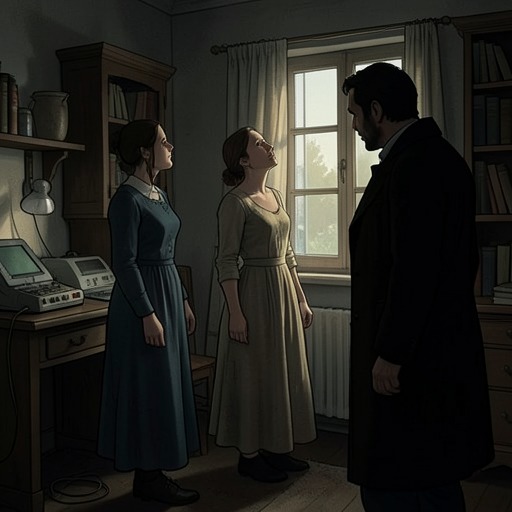
Old Fauchelevent
Les MisérablesOld Fauchelevent is an elderly man first encountered trapped beneath his overturned cart in Montreuil-sur-Mer. His rescue by M. Madeleine turns a moment of physical danger into a lasting obligation of gratitude: once Old Fauchelevent has recovered, he is given work as a gardener at a convent in Paris, and later repays the kindness by sheltering Jean Valjean and Cosette. His small but consequential role links an act of bodily courage to the refuge that protects them from pursuit.
Identity and First Appearance
Old Fauchelevent is introduced as an old man whose cart has fallen after its horse collapses in an unpaved lane. The horse has broken both its thighs and cannot rise; Old Fauchelevent is caught between the wheels, with the heavily loaded vehicle pressing on his chest. His cries make the danger immediate, but the difficulty is not simply reaching him: the cart must be lifted from beneath, and careless pulling or jolting could kill him.
The scene establishes him first through helplessness and peril, not through a history or an account of his character. He is a particular vulnerable body caught under a weight that the surrounding people cannot shift safely. Inspector Javert arrives and sends for a jack, but before it comes, M. Madeleine reaches the scene. Old Fauchelevent’s predicament thus becomes the occasion for a public test of Madeleine’s willingness to risk himself for another person.
The Rescue Beneath the Cart
M. Madeleine looks toward Inspector Javert, whose watchful gaze remains fixed on him, and then at the motionless country people. Without speaking, he drops to his knees and crawls beneath the cart. The action places him in the same deadly confinement as Old Fauchelevent: he tries twice to bring his elbows toward his knees, while those watching and Old Fauchelevent himself urge him to withdraw. He does not answer them.
The suspense turns on the cart’s weight and the narrowing possibility of escape. Its wheels continue sinking into the rut, leaving Madeleine almost unable to get back out. Then the mass begins to move; the wheels rise partway from the rut as Madeleine makes one last effort and calls for help. The assembled people rush in, and twenty arms lift the cart. Old Fauchelevent is saved. The narrative makes the rescue a collective achievement, but stresses its initiating force: the self-sacrifice of one man gives the others strength and courage to act.
Madeleine emerges pale, drenched with sweat, and covered in mud, his clothes torn. Old Fauchelevent kisses his knees and calls him a good God; Madeleine, meanwhile, looks toward Inspector Javert with a calm eye and an expression described as both suffering and happiness. The rescue therefore leaves more than a physical outcome. Old Fauchelevent’s gratitude is immediate and bodily, while Inspector Javert’s continued scrutiny places the act under an observer’s gaze. Courage and suspicion occupy the same scene, without diminishing the fact that the old man has been saved.
A New Life as a Gardener
After Old Fauchelevent recovers, M. Madeleine uses his recommendations to secure him a position as a gardener at a convent in the Saint-Antoine quarter of Paris. The appointment gives the rescue a practical continuation: Madeleine’s intervention does not end when the cart is lifted, but helps provide Old Fauchelevent with work and a place in a new setting. His subsequent occupation is also what brings him into contact with the convent where he will later be able to help Jean Valjean.
The move from Montreuil-sur-Mer to Paris connects Old Fauchelevent’s personal fortune to the wider movement of the novel. He is no longer merely the old man at the roadside; his place as gardener gives him access to the convent garden and a household from which he can act. The evidence presents this change directly through his recovery, recommendation, and new employment, rather than through any account of what he thinks about the change.
Recognition and Return of the Favor
When Jean Valjean flees with Cosette because he believes Inspector Javert is spying on him, he takes refuge in the garden of the Paris Petit-Picpus Convent. Old Fauchelevent recognizes him there. He responds by installing Jean Valjean in his own quarters and presenting him as his brother, while Cosette enters the sisters’ boarding school. The earlier rescue has thus acquired a second consequence: the man once lifted out from under a cart now helps shelter the rescuer’s fellow fugitive and the child in his care.
Old Fauchelevent’s assistance depends on both recognition and action. Recognition makes the unexpected meeting meaningful; the brotherhood he claims gives Jean Valjean a way to remain at the convent, and Cosette’s entry into the school secures her place within its protection. The account does not elaborate Old Fauchelevent’s private motives, but the sequence makes the reciprocity plain. Madeleine’s earlier help had secured his recovery and employment; when danger reaches the convent garden, he uses the position that followed that help to offer refuge in return.
Narrative Role
Old Fauchelevent links two episodes separated by a change of place and circumstance. The first centers on a trapped body, a perilous act beneath a cart, and a crowd moved into action; the later episode turns on a recognized face, a concealed identity, and the quiet provision of shelter. In each, help is made effective through another person’s intervention: the cart is lifted after Madeleine’s effort, and Jean Valjean and Cosette find safety through Old Fauchelevent’s welcome and explanation.
His importance lies less in an extended personal story than in the consequences of these encounters. The rescue makes his recovery and convent post possible; that post makes his later assistance possible. In this way, an act of compassion on a road in Montreuil-sur-Mer reaches forward into the hidden life of Jean Valjean and Cosette in Paris. Old Fauchelevent becomes the human connection between the moment of rescue and the refuge that follows.